
Bonus questions for tests
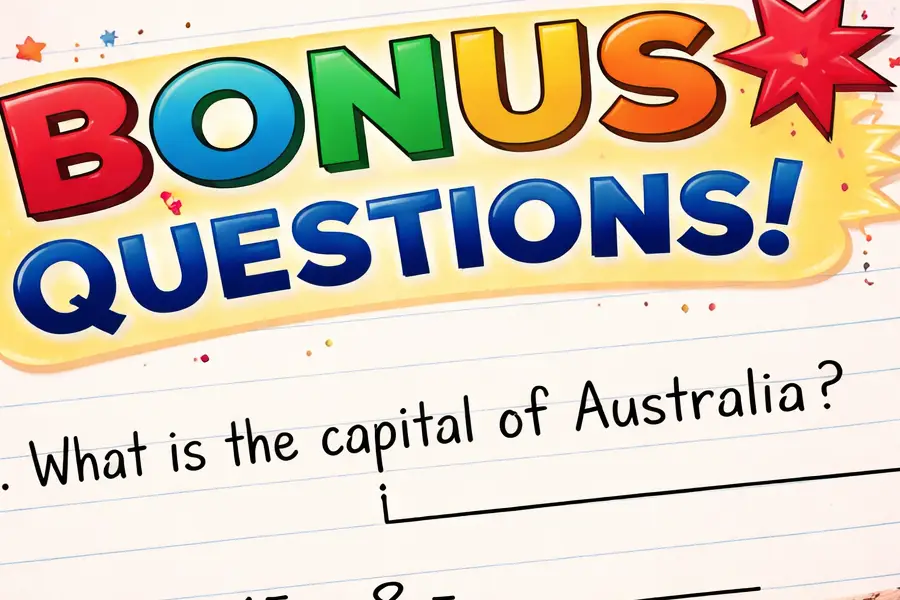
Bonus questions for tests are a popular way for educators to challenge students beyond standard curriculum requirements while offering an opportunity to earn extra credit. These questions often encourage critical thinking, creativity, and broader knowledge across multiple subjects, making exams more engaging and rewarding for learners.
For more questions or quizzes, see our website
Bonus questions for tests questions
- What is the capital of France?
- Who wrote the play Romeo and Juliet?
- What is the chemical symbol for gold?
- Which planet is known as the Red Planet?
- Who was the first President of the United States?
- What is the largest ocean on Earth?
- What is 12 × 12?
- Who painted the Mona Lisa?
- What gas do plants absorb from the atmosphere?
- What year did World War II end?
- What is the square root of 144?
- Who discovered gravity?
- What is the longest river in the world?
- What language has the most native speakers?
- What is the smallest prime number?
- Who invented the telephone?
- What continent is Egypt located on?
- What is the freezing point of water in Celsius?
- Who was the first person to walk on the Moon?
- What is the hardest natural substance on Earth?
- What is the capital of Japan?
- What organ pumps blood through the human body?
- What is the main ingredient in bread?
- Who wrote Harry Potter?
- What is the speed of light?
- What is the tallest mountain in the world?
- What is the chemical formula for water?
- Who developed the theory of relativity?
- What is the largest mammal?
- What is the currency of the United Kingdom?
- How many continents are there?
- What is the boiling point of water in Celsius?
- Who was known as the “Father of Computers”?
- What is the main language spoken in Brazil?
- What is the value of π (pi) rounded to two decimals?
- Who was the first woman to win a Nobel Prize?
- What part of the plant conducts photosynthesis?
- What is the largest desert in the world?
- What does DNA stand for?
- Who wrote The Odyssey?
- What is the capital of Canada?
- What force keeps planets in orbit?
- What is the main source of energy for Earth?
- Who invented the light bulb?
- What is the longest bone in the human body?
- What is the study of weather called?
- What country gifted the Statue of Liberty to the U.S.?
- What is the main ingredient in glass?
- What instrument measures earthquakes?
- What is the largest internal organ in the human body?
- What is the capital of Australia?
- What element has the atomic number 1?
- Who wrote 1984?
- What is the main function of the lungs?
- What is the fastest land animal?
- What galaxy do we live in?
- What is the chemical symbol for oxygen?
- Who painted the Sistine Chapel ceiling?
- What is the largest continent?
- What does UNESCO stand for?
Bonus questions for tests answers
- Paris
- William Shakespeare
- Au
- Mars
- George Washington
- Pacific Ocean
- 144
- Leonardo da Vinci
- Carbon dioxide
- 1945
- 12
- Isaac Newton
- Nile River
- Mandarin Chinese
- 2
- Alexander Graham Bell
- Africa
- 0°C
- Neil Armstrong
- Diamond
- Tokyo
- Heart
- Flour
- J.K. Rowling
- Approximately 299,792 km/s
- Mount Everest
- H₂O
- Albert Einstein
- Blue whale
- Pound sterling
- Seven
- 100°C
- Charles Babbage
- Portuguese
- 3.14
- Marie Curie
- Leaves
- Antarctica
- Deoxyribonucleic acid
- Homer
- Ottawa
- Gravity
- The Sun
- Thomas Edison
- Femur
- Meteorology
- France
- Sand
- Seismograph
- Liver
- Canberra
- Hydrogen
- George Orwell
- Oxygen exchange
- Cheetah
- Milky Way
- O
- Michelangelo
- Asia
- United Nations Educational, Scientific and Cultural Organization
Bonus questions add excitement and flexibility to exams by rewarding curiosity, broad knowledge, and higher-level thinking. Whether used to break ties, motivate students, or simply make assessments more enjoyable, bonus questions for tests can transform the testing experience into a more positive and engaging challenge. When thoughtfully designed, they encourage learning beyond memorization and inspire students to explore subjects more deeply. To better understand the educational value of assessment methods, you can explore more about educational assessment and how creative questioning supports student growth.

Related Posts